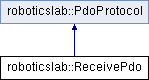
Representation of RPDO protocol.
#include <PdoProtocol.hpp>
|
|
| ReceivePdo (std::uint8_t id, std::uint16_t cob, unsigned int n, SdoClient *sdo, ICanSenderDelegate *sender=nullptr) |
| | Constructor, registers SDO and CAN sender handles.
|
| |
|
void | configureSender (ICanSenderDelegate *sender) |
| | Configure CAN sender delegate handle.
|
| |
| template<typename... Ts> |
| bool | write (Ts... data) |
| | Send data to the drive.
|
| |
|
| PdoProtocol (std::uint8_t id, std::uint16_t cob, unsigned int n, SdoClient *sdo) |
| | Constructor, registers SDO client handle.
|
| |
|
virtual | ~PdoProtocol ()=default |
| | Virtual destructor.
|
| |
|
std::uint16_t | getCobId () const |
| | Retrieve COB ID.
|
| |
|
bool | configure (const PdoConfiguration &config) |
| | Configure this PDO drive-side via SDO packages.
|
| |
|
|
template<typename T > |
| void | pack (const T *data, std::uint8_t *buff, unsigned int *count) |
| |
|
void | packInternal (std::uint8_t *buff, const void *data, unsigned int size) |
| |
|
bool | writeInternal (const std::uint8_t *data, unsigned int size) |
| |
|
| enum class | PdoType { RPDO
, TPDO
} |
| | PDO type.
|
| |
|
template<typename... Tn> |
| static constexpr std::size_t | size () |
| |
|
std::uint8_t | id |
| |
|
std::uint16_t | cob |
| |
|
unsigned int | n |
| |
|
SdoClient * | sdo |
| |
◆ getType()
| PdoType roboticslab::ReceivePdo::getType |
( |
| ) |
const |
|
inlineoverrideprotectedvirtual |
◆ write()
template<typename... Ts>
| bool roboticslab::ReceivePdo::write |
( |
Ts... |
data | ) |
|
|
inline |
Usually, you'll want to pass as many parameters as CAN dictionary objects have been mapped. Only integral types allowed, cumulative size cannot exceed 8 bytes.
The documentation for this class was generated from the following files:
- libraries/CanOpenNodeLib/PdoProtocol.hpp
- libraries/CanOpenNodeLib/PdoProtocol.cpp
 Public Member Functions inherited from roboticslab::PdoProtocol